
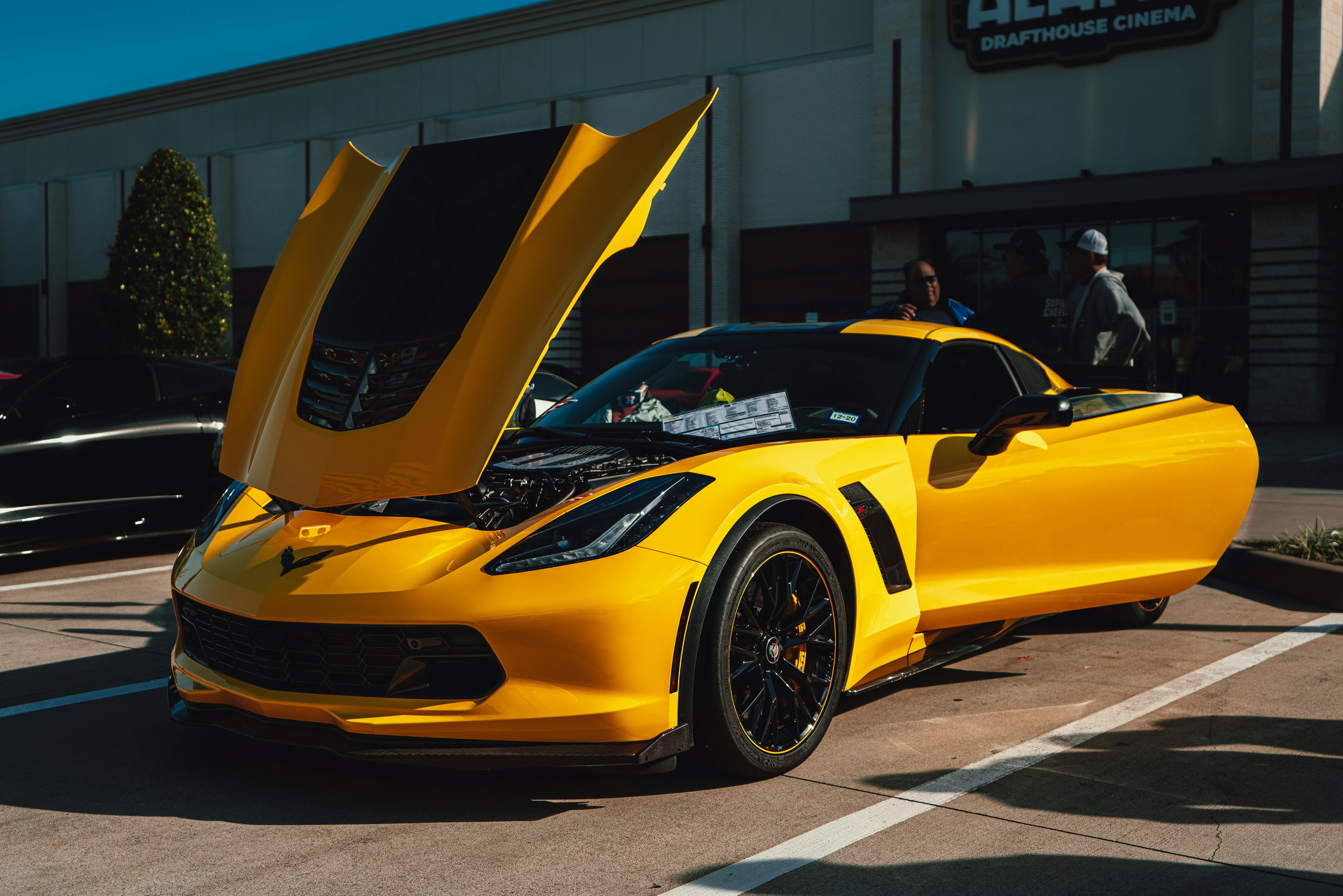
For more than 70 years, the Corvette has symbolized American performance, innovation, and bold design. Since its debut in 1953, Chevrolet’s sports car has constantly evolved — sometimes refining a winning formula, other times completely reinventing itself. Along the way, certain models rose above the rest. Some became legends because of their styling. Others earned respect through groundbreaking engineering or jaw-dropping performance numbers.
These are the Corvettes that didn’t just sell well or win races — they changed the trajectory of America’s sports car forever.
1963 Split-Window Sting Ray
Few cars in automotive history are as instantly recognizable as the 1963 Split-Window Sting Ray. Officially part of the C2 generation, the 1963 Corvette coupe introduced one of the most dramatic design elements ever seen on a production sports car: a divided rear window separated by a central spine.
The split-window design was the vision of Corvette’s legendary chief stylist Bill Mitchell, who drew inspiration from racing prototypes. The result was stunning — futuristic, aggressive, and unmistakable. However, the divided rear glass created visibility concerns, and under pressure, Chevrolet eliminated it after just one model year. That one-year-only production instantly elevated the 1963 coupe into collector royalty.
But the 1963 model wasn’t just about styling. It also introduced a fully independent rear suspension — a major leap forward from the solid rear axle used in previous generations. This dramatically improved handling and ride quality, bringing the Corvette closer to European sports car standards.
Performance options ranged from small-block V8s to the fuel-injected 327 cubic-inch engine producing up to 360 horsepower — serious numbers for the early 1960s. Combined with its lightweight fiberglass body and improved chassis, the 1963 model wasn’t just beautiful — it was fast and capable.
Today, the 1963 Chevrolet Corvette Sting Ray remains one of the most valuable and admired Corvettes ever built. It represents the moment when the Corvette matured from stylish cruiser into a true performance machine.
1967 Big-Block Corvette
If the 1963 model introduced sophistication, the 1967 Corvette perfected the muscle-era formula. The final year of the C2 generation is widely regarded by enthusiasts as the pinnacle of classic Corvette design and engineering.
By 1967, Chevrolet had refined the Sting Ray’s styling into something clean, aggressive, and purposeful. Gone were the fender vents and excessive trim of earlier models. In their place was a streamlined, muscular silhouette that looked fast even when standing still.
Under the hood, things got serious. The available big-block V8 engines — including the legendary L71 427 cubic-inch engine — produced up to 435 horsepower (and likely much more in real-world output). With massive torque and straight-line acceleration that could embarrass almost anything on the road, the 1967 Corvette embodied the raw power of the American muscle era.
Yet it wasn’t just about brute force. The 1967 model year also offered upgraded suspension components, improved braking systems, and options like side-mounted exhaust pipes, which added both performance and visual drama.
The 1967 Chevrolet Corvette stands today as one of the most collectible Corvettes ever produced. Low production numbers and its status as the final and most refined C2 model make it a blue-chip classic in the collector car world.
For many, 1967 represents the ultimate expression of the classic front-engine, big-block Corvette formula.
1990 ZR-1 – “King of the Hill”
Fast forward to 1990, and the Corvette world was about to be shocked. The arrival of the ZR-1 marked a dramatic shift in philosophy. Rather than relying purely on displacement and muscle-car heritage, Chevrolet pursued advanced engineering and global performance credibility.
Nicknamed “King of the Hill,” the 1990 Chevrolet Corvette ZR-1 featured the revolutionary LT5 engine — a 5.7-liter V8 with dual overhead camshafts and 32 valves. Developed with assistance from Lotus, this high-tech powerplant produced 375 horsepower at launch, later increased to 405 horsepower.
For 1990, those numbers were staggering. The ZR-1 could exceed 175 mph, placing it firmly in European supercar territory. It wasn’t just quick in a straight line either — its upgraded suspension, wide rear tires, and performance-focused tuning gave it serious track capability.
Visually, the ZR-1 distinguished itself with a wider rear end and unique badging, but it retained the C4’s recognizable wedge shape. It was subtle compared to many supercars, yet brutally effective.
More importantly, the ZR-1 proved something critical: the Corvette could compete globally on technology and refinement, not just horsepower per dollar. It signaled that America’s sports car was no longer content playing in a domestic sandbox.
2009 ZR1 – Supercharged Supercar Slayer
Nearly two decades later, Chevrolet once again redefined expectations with the C6-generation ZR1 (note the slight name change from ZR-1 to ZR1). The 2009 Chevrolet Corvette ZR1 delivered 638 horsepower from its supercharged 6.2-liter LS9 V8 — making it the most powerful production Corvette ever built at the time.
This wasn’t just incremental progress. It was a full-scale assault on the supercar establishment.
With a top speed over 200 mph and Nürburgring lap times that rivaled European exotics costing twice as much, the 2009 ZR1 became a benchmark for performance value. Carbon fiber body panels, a transparent hood window showcasing the supercharger, magnetic ride control, and advanced aerodynamics demonstrated how far the Corvette had evolved.
Critics who once dismissed the Corvette as crude were forced to reconsider. The ZR1 offered world-class speed, composure, and track durability — without abandoning its American identity.
For many enthusiasts, the C6 ZR1 represents the ultimate expression of the front-engine Corvette platform before the revolutionary shift to mid-engine design.
C8 Z06 – A New Era of Performance
The introduction of the mid-engine C8 generation in 2020 fundamentally changed the Corvette’s layout and capabilities. But it was the Z06 variant that truly demonstrated how far the car had progressed.
The Chevrolet Corvette Z06 features a naturally aspirated 5.5-liter flat-plane crank V8 — a configuration more commonly associated with exotic European brands. Revving beyond 8,000 RPM and producing over 650 horsepower, it delivers a sound and character unlike any Corvette before it.
The mid-engine layout dramatically improves weight distribution, traction, and cornering balance. Combined with aggressive aerodynamics, massive brakes, and track-focused suspension tuning, the C8 Z06 is engineered to dominate road courses.
This model represents a philosophical shift. Where earlier Corvettes often emphasized straight-line muscle, the C8 Z06 is precision-focused — designed from the ground up as a world-class track machine.
It proves that the Corvette is no longer just competing with European performance cars — it belongs in the same conversation.
Why These Models Matter
Each of these iconic Corvettes represents a turning point:
- The 1963 Split-Window Sting Ray redefined design and chassis sophistication.
- The 1967 Big-Block perfected the muscle-era formula.
- The 1990 ZR-1 introduced advanced engineering and global ambition.
- The 2009 ZR1 shattered performance ceilings for the front-engine platform.
- The C8 Z06 ushered in a mid-engine supercar era.
They are prized not only for rarity or horsepower, but for what they symbolize. Each model pushed boundaries and forced the automotive world to pay attention.
The Corvette’s story is one of constant reinvention. It adapts to new technology, new performance standards, and new competitors — yet it never loses its core identity as America’s sports car.
That enduring ability to evolve is what keeps the Corvette relevant decade after decade.
It’s not just a car.
It’s a moving timeline of American performance history — and the legend is still being written.