
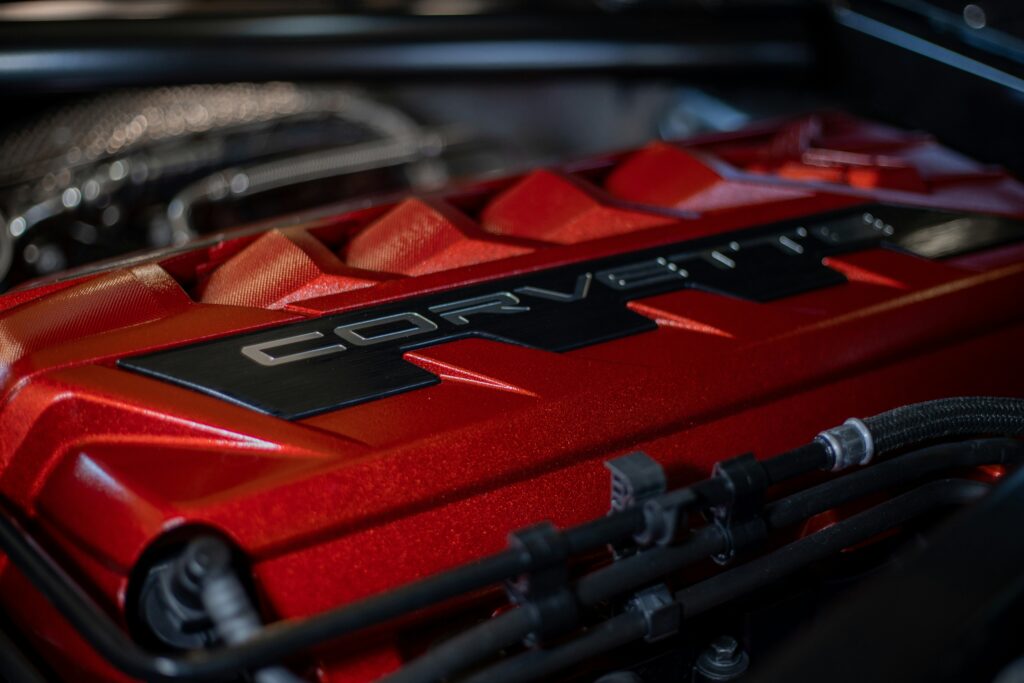
When Chevrolet unveiled the mid-engine C8 Corvette, it wasn’t just introducing a new generation of America’s sports car — it was signaling a seismic shift in the global performance landscape. For nearly 70 years, the Corvette had remained front-engine, rear-wheel drive. Meanwhile, the world’s most exotic and celebrated supercars from Europe had long embraced the mid-engine formula as the gold standard for balance and performance.
With the arrival of the C8, that changed overnight.
The C8 Corvette didn’t simply evolve — it redefined what American performance could be. And in doing so, it forced direct comparisons with European legends like the Ferrari and Lamborghini.
The Mid-Engine Advantage
For decades, mid-engine architecture has been associated with precision engineering and elite performance. By placing the engine behind the driver but ahead of the rear axle, weight distribution improves dramatically. This layout enhances balance, reduces understeer, sharpens turn-in response, and improves traction under acceleration.
European manufacturers mastered this formula years ago. Vehicles such as the Ferrari F8 Tributo and the Lamborghini Huracán rely on mid-engine layouts to deliver world-class cornering capability and razor-sharp handling.
When Chevrolet introduced the C8 Corvette, it adopted this same engineering philosophy. The move wasn’t cosmetic — it was transformative. Compared to previous front-engine Corvettes, the C8 delivers a lower center of gravity, improved weight balance, and significantly better traction when accelerating out of corners.
For Corvette enthusiasts, this was the realization of a dream that engineers had discussed for decades. For competitors, it was a warning shot.
Performance Numbers That Shocked the Industry
When the base C8 launched, it produced 495 horsepower with the Z51 performance package. That number alone is impressive — but the headline statistic was its 0–60 mph time of under three seconds.
That level of acceleration once required a six-figure European exotic. Cars wearing prancing horses or raging bulls had long dominated this performance bracket. Yet here was an American sports car delivering supercar acceleration at a fraction of the cost.
The price difference is what truly shook the industry. While many European supercars routinely begin north of $200,000 — and often climb well beyond that with options — the C8 entered the market at a starting price closer to that of a luxury sedan.
Performance per dollar became the Corvette’s strongest argument.
And it didn’t stop there. The introduction of the Chevrolet Corvette Z06 elevated the conversation even further. Featuring a flat-plane crank V8 and a screaming redline reminiscent of European exotics, the Z06 blurred the line between American muscle and Italian thoroughbred. Suddenly, the Corvette wasn’t just matching European supercars in acceleration — it was challenging them in character and sound.
Interior and Technology: Closing the Gap
Historically, one of the most common criticisms of Corvettes involved interior quality. While performance was often exceptional, critics argued that European rivals offered more refined cabins, higher-end materials, and superior craftsmanship.
The C8 changed that narrative in dramatic fashion.
The cockpit is unapologetically driver-focused, with a dramatic center console that wraps around the pilot. Digital displays replace analog gauges, offering customizable performance data and track telemetry. Premium materials, stitched leather, and carbon fiber accents create an atmosphere that feels far more upscale than Corvettes of the past.
The shift to an 8-speed dual-clutch transmission marked another major evolution. Previous generations offered manual gearboxes, beloved by purists. But to compete directly with European exotics, Chevrolet opted for lightning-fast, computer-controlled shifts. The result is seamless acceleration comparable to the transmissions found in high-end European supercars.
While luxury purists may still argue that certain European brands maintain a slight edge in tactile refinement or brand prestige, the gap has narrowed dramatically — far more than many expected.
Track Capability and Engineering Depth
Straight-line speed is only one measure of a supercar. Sustained performance on a road course is where engineering truly shines.
Chevrolet’s performance team focused intensely on aerodynamics, cooling systems, and chassis rigidity when developing the C8. The mid-engine layout allowed for improved airflow management and enhanced structural stiffness. Larger brakes and advanced suspension geometry enable confident, repeatable performance during track sessions.
Independent testing has shown that the C8 can lap alongside — and in some cases outperform — significantly more expensive European competitors. That reality would have been nearly unthinkable just a decade ago.
The Corvette has always delivered impressive speed. What makes the C8 different is its composure. It feels planted, predictable, and precise — traits traditionally associated with Europe’s elite performance brands.
The Psychological Shift
Perhaps the C8’s greatest impact isn’t measured in horsepower or lap times — it’s measured in perception.
For decades, American sports cars were viewed as brute-force machines: massive engines, straight-line dominance, and aggressive styling. European supercars, by contrast, were seen as refined instruments of precision engineering.
The C8 disrupted that stereotype.
Its sharp, angular design looks more like an Italian exotic than a traditional American muscle car. Its mid-engine proportions fundamentally changed how people perceive the Corvette silhouette. Parked next to European exotics, the C8 no longer appears out of place — it looks like it belongs.
This shift matters because perception shapes the market. Buyers who may never have considered an American sports car are now taking a second look.
Value vs Prestige
Does the C8 Corvette replace a Ferrari or Lamborghini in terms of heritage and exclusivity? That depends on what a buyer prioritizes.
European supercars carry decades of racing pedigree, limited production numbers, and brand cachet that extends beyond raw performance. Ownership often includes an element of status and exclusivity that transcends numbers on a spec sheet.
The Corvette, however, has always championed accessibility. It delivers extraordinary performance without requiring generational wealth. That philosophy remains intact with the C8 — but now it does so with engineering sophistication that rivals global elites.
In measurable categories — acceleration, braking, handling, technology, and price-to-performance ratio — the C8 is not merely competitive. It is disruptive.
The Game Has Changed
The introduction of the mid-engine C8 Corvette represents one of the boldest decisions in American automotive history. Chevrolet could have continued refining the traditional front-engine formula. Instead, it reinvented its flagship sports car entirely.
In doing so, it elevated the Corvette into a new class.
The C8 didn’t just join the supercar conversation — it forced it to evolve. European manufacturers now face a competitor that delivers comparable performance at a dramatically lower cost. The ripple effect is already visible in the performance market.
America’s sports car is no longer defined by compromise or caveat. The C8 Corvette stands as proof that world-class engineering knows no geographic boundary.
And for the first time, when discussing the world’s great supercars, leaving Corvette out of the conversation simply isn’t an option anymore.