
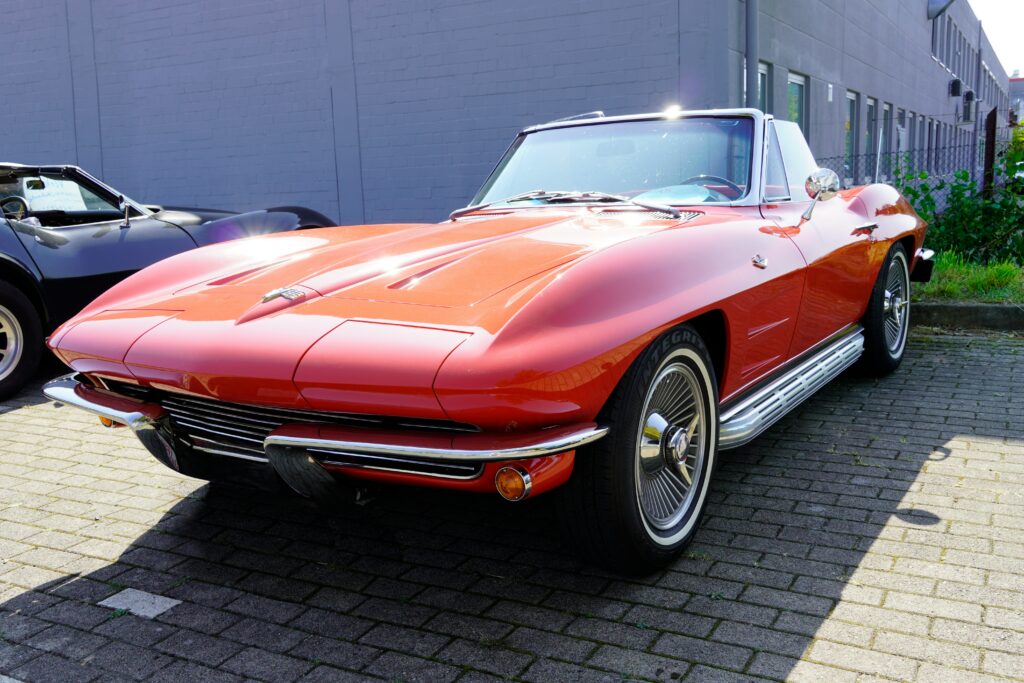
Few vehicles in American automotive history carry the prestige, heritage, and performance reputation of the Chevrolet Corvette. For more than seven decades, the Corvette has stood as a symbol of innovation, speed, and bold American design. It has weathered economic downturns, oil crises, emissions crackdowns, and fierce global competition — yet it continues to thrive. From its fiberglass-bodied beginnings in 1953 to today’s mid-engine supercar configuration, the Corvette has constantly reinvented itself while staying true to its identity as America’s sports car.
The Birth of an American Icon (C1: 1953–1962)
The Corvette story began in 1953 when it debuted at the General Motors Motorama show in New York City. At the time, American automakers were noticing the popularity of lightweight European sports cars returning from World War II. Chevrolet wanted to build something similar — but distinctly American.
The first-generation Corvette, now known as the C1, featured a revolutionary fiberglass body. This was a bold move in an era when steel dominated automotive manufacturing. Fiberglass allowed for lighter weight and more sculpted styling, setting the Corvette apart immediately.
However, early performance did not match the car’s sporty looks. The 1953 Corvette came equipped with a modest inline-six engine paired to a two-speed automatic transmission. It looked fast, but it wasn’t yet a true performance contender.
Everything changed in 1955 when Chevrolet introduced the small-block V8 engine. This addition transformed the Corvette from a stylish cruiser into a legitimate sports car. Horsepower increased dramatically, acceleration improved, and enthusiasts began taking the Corvette seriously. By the late 1950s, the Corvette had earned a growing reputation for performance, especially with the introduction of fuel injection in 1957 — a cutting-edge feature at the time.
The foundation was set. The Corvette was no longer just an experiment. It was becoming a performance icon.
Sting Ray Era and Muscle Power (C2 & C3: 1963–1982)
In 1963, Chevrolet introduced what many consider the most beautiful Corvette ever built: the second-generation C2 Sting Ray. The design was sharp, aggressive, and futuristic. Hidden headlights, sculpted fenders, and the now-legendary split rear window coupe (available only in 1963) made it an instant classic.
Under the hood, the horsepower wars were escalating. Big-block V8 engines pushed output beyond 400 horsepower, turning the Corvette into a true American muscle machine. During the height of the muscle car era, the Corvette stood at the top of Chevrolet’s performance hierarchy.
The third-generation C3 debuted in 1968, heavily inspired by the Mako Shark II concept car. Its flowing curves and dramatic body lines defined the Corvette look throughout the 1970s. Sales were strong, and the Corvette became a cultural symbol of American performance and style.
However, the 1970s brought challenges. Stricter emissions regulations and the oil crisis led to significant horsepower reductions across the automotive industry. Corvette performance dipped during this period, but its image endured. Even when power numbers fell, the Corvette remained aspirational — a car people dreamed of owning.
Modern Performance Takes Shape (C4–C6: 1984–2013)
After skipping the 1983 model year entirely, Chevrolet launched the C4 Corvette in 1984. This generation marked a major technological leap forward. The C4 featured a completely redesigned chassis, improved aerodynamics, and advanced suspension systems that prioritized handling precision.
Inside, digital dashboards and modernized interiors signaled that the Corvette was stepping into a new era. Performance steadily improved throughout the C4’s lifespan, culminating in high-performance variants like the ZR-1, which reestablished the Corvette as a serious global competitor.
The fifth-generation C5 (1997–2004) represented another transformative leap. It introduced the LS engine family — powerplants that would become legendary for their durability, efficiency, and tuning potential. The C5 also featured a rear-mounted transaxle, improving weight distribution and balance. This engineering refinement significantly enhanced handling and made the Corvette more competitive against European sports cars.
Then came the C6 (2005–2013), which refined the formula further. Pop-up headlights were retired, weight was reduced, and performance increased. High-performance models like the Z06 and the supercharged ZR1 delivered astonishing speed at a price far lower than comparable European supercars. By this point, the Corvette wasn’t just competing — it was outperforming many of its rivals in value and raw capability.
The Front-Engine Finale (C7: 2014–2019)
The seventh-generation C7 Corvette marked the end of the traditional front-engine era. Aggressive styling, sharp creases, and a driver-focused cockpit gave it a modern, purposeful look. Under the hood, the LT1 V8 delivered strong naturally aspirated performance, while higher trims like the Z06 and ZR1 pushed output beyond 650 horsepower.
The C7 combined brute strength with sophisticated handling. Magnetic ride control, advanced aerodynamics, and performance data recorders reflected how far technology had advanced since 1953.
By this stage, the Corvette had evolved into a world-class performance machine. It was no longer just America’s sports car — it was a legitimate global contender capable of standing toe-to-toe with vehicles costing twice as much.
Yet Chevrolet engineers had long dreamed of going even further.
The Mid-Engine Revolution (C8: 2020–Present)
In 2020, Chevrolet stunned the automotive world by unveiling the first-ever mid-engine Corvette: the C8. For decades, Corvette engineers had experimented with mid-engine concepts dating back to the 1960s. Moving the engine behind the driver promised better weight distribution, improved traction, and enhanced handling balance.
The C8 finally made that dream a production reality.
Visually, the transformation was dramatic. The proportions shifted, the nose shortened, and the cabin moved forward. The Corvette suddenly looked like an exotic European supercar. But unlike many mid-engine competitors, it maintained a starting price that remained relatively accessible compared to six-figure exotics.
Performance matched the bold design. The mid-engine layout improved acceleration and cornering stability. Later variants pushed the envelope even further, solidifying the Corvette’s place in supercar territory.
The C8 was not simply a redesign — it was the culmination of nearly 70 years of engineering ambition. It proved that even icons are willing to reinvent themselves.
Why the Corvette Still Matters
The Corvette’s survival is no accident. It has endured because it adapts. When emissions regulations tightened, it evolved. When technology advanced, it embraced innovation. When global competition intensified, it stepped up its game.
Perhaps most importantly, the Corvette has consistently delivered exceptional performance per dollar. While many sports cars drift into ultra-luxury pricing, the Corvette has remained aspirational yet attainable. That balance has kept it relevant across generations.
Each iteration reflects the era in which it was built — from the optimism of the 1950s to the muscle car bravado of the 1960s, the challenges of the 1970s, the technological leap of the 1980s and 1990s, and today’s high-tech supercar landscape.
From fiberglass beginnings to mid-engine precision, the evolution of the Corvette proves one thing: true icons don’t stand still. They evolve — and in doing so, they define the future while honoring the past.